

You don't arrive in Varanasi.
Varanasi arrives at you — somewhere between the rickshaw horn and the smell of marigold-and-woodsmoke, somewhere in the gap where the lane narrows and a cow decides, with the full authority of a minor god, that it will not be moving for anyone. One minute you're a tourist with a booking confirmation and a loose plan. The next, you're a small damp human at the edge of a river that's been swallowing prayers, ashes, sins, and selfie-sticks for three thousand years, and the river does not look up.
That's the thing nobody puts in the reel: Varanasi doesn't care that you came.
I'm not going to pretend I "did" a city older than history. I went to a handful of places, ate like a happy idiot, stood too close to death one afternoon, and came away rearranged. This is all of it — what I actually saw, what it cost (ca$hmonies and otherwise), and the stuff I'm still arguing with myself about.
First — where the hell are you
Quick map stuff, because mysticism won't help you find your guesthouse at 2am.
Varanasi — also Banaras, also Kashi, same soul, three names — sits in the eastern belly of Uttar Pradesh, slung along the western bank of the Ganga. City of Shiva. One of the oldest continuously inhabited cities on Earth. Not old like a monument. Old like it never once stopped. Kashi means "the luminous one," the City of Light, and the whole place arranges itself around the river in a long crescent of ghats — the stone staircases that run down to the water, where bathing, laundry, grief, commerce, and the full theatre of being alive all happen at the exact edge of the holy and the filthy (which, in Banaras, are the same thing, and nobody apologises).
Here's where I went.
Dashashwamedh: the river puts on a show
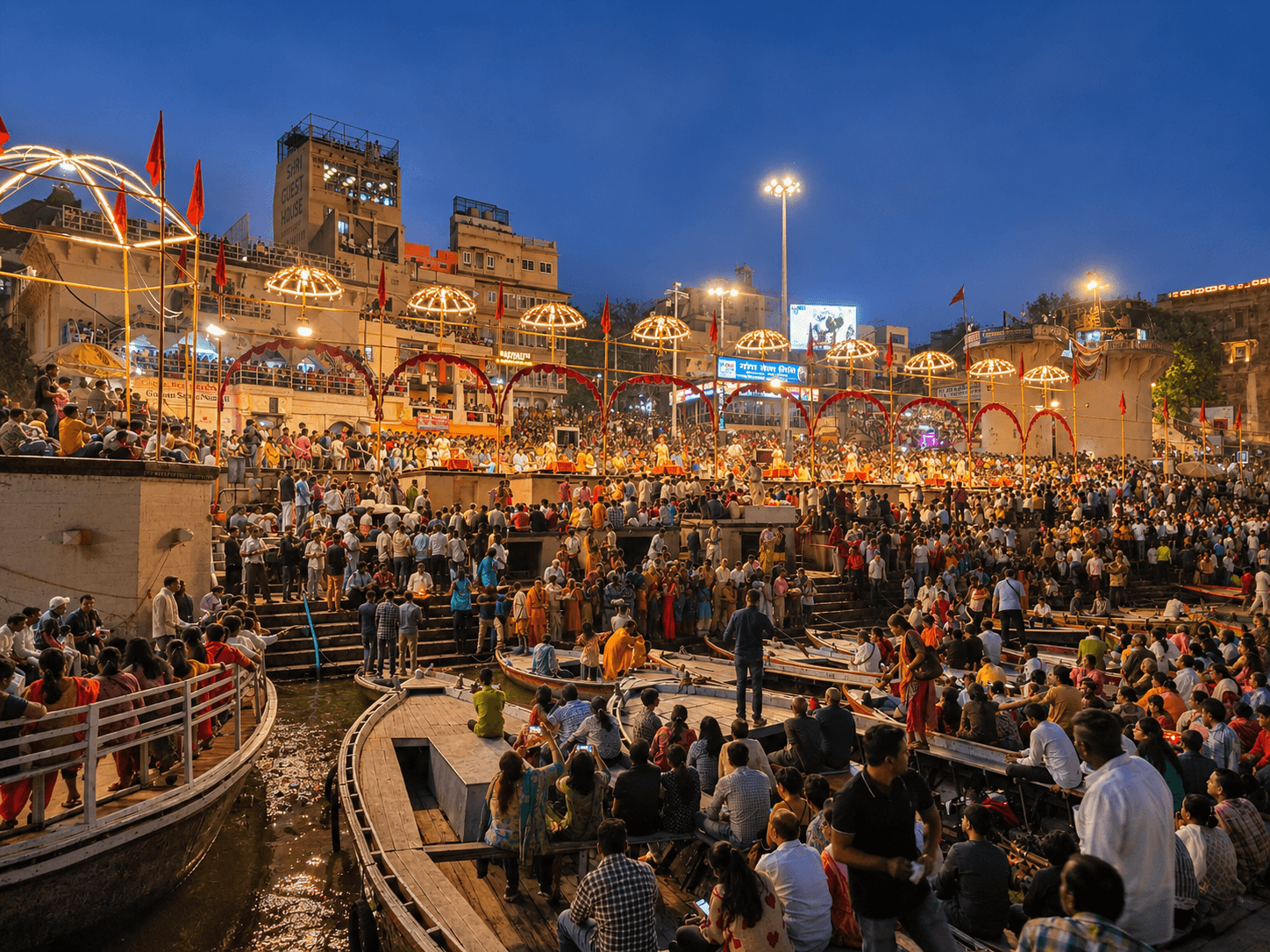
Dashashwamedh is the main ghat, and every evening it does the thing you came to see whether you admit it or not: the Ganga Aarti.
At dusk the priests line up in a row, young men in matching robes, and for the better part of an hour they offer fire to the river — towering brass lamps swung in slow circles, conch shells, a wall of bells, incense thick enough to lean on, the crowd pressed shoulder to sweaty shoulder, boats rafted together on the black water with a thousand phones glowing back at the flames.
Is it a spectacle for tourists? Yes. Is it also real devotion, performed the same way for longer than your country has had a flag? Also yes. Both. Always both. I stood there half-cynical, arms crossed (herp derp, another fire show) — and then the bells hit a certain pitch and something in my chest went quiet anyway. The city wins that argument every time.
Tip: get there a solid 45 minutes early for a step with a view, or hire a little boat and watch from the water, which is honestly the better seat.
Manikarnika: the fire that never goes out
And then there's the other fire.
Manikarnika is the great burning ghat, where the dead are cremated in the open, all day, every day, and have been for centuries. They say the flame here has never gone out. They say that to die in Kashi — to burn on these steps — is to break the cycle of rebirth itself. Moksha. Release. People travel across the whole country to end here on purpose.
So you turn a corner expecting another pretty ghat and instead there are pyres. Stacked firewood sold by weight. Families carrying a shrouded body down to the water. Smoke you'll smell in your clothes that night. The Dom community tending the fires — the people whose caste has handled death here for generations, holding up an entire cosmology with their bare hands while the rest of society looks away from them.
Cameras down. Not because a sign says so — because you'll know. This is the part of the trip I still can't tidy into a neat paragraph. I came with clean shoes and the quiet, unearned confidence of someone who can leave whenever they want, and I stood watching strangers grieve their fathers as if it were content. It wasn't. It was the most honest thing I saw in India, and I didn't have the right to it, and I looked anyway. I'm still sitting with that.
Aadi Shakti Maa Durga: the red temple
After the fire, I needed a different kind of sacred, and the Aadi Shakti Maa Durga temple gives it — the 18th-century Durga shrine the whole city just calls the red temple, washed in that deep ochre-red, dedicated to the Mother, the primal feminine force, Shakti herself. There's the old tank of water beside it and the monkeys who run the place like they're on payroll (they are not your friends; guard your snacks with your life).
No spectacle here. Just the steady traffic of people who actually believe, slipping in, bowing, moving on. Faith as a Tuesday. After Manikarnika it felt less like worship and more like someone exhaling.
BHU: the city exhales
Speaking of exhaling — Banaras Hindu University is where Varanasi stops screaming for a minute.
Founded in 1916 by Madan Mohan Malaviya, it's one of the largest residential universities in Asia, and crossing its gate is genuinely disorienting after the old city: wide avenues, actual trees, students on bicycles, space. At its heart stands the New Vishwanath Temple — tall, pale, marble-calm, open to everyone regardless of who they pray to — and if you've got an hour, Bharat Kala Bhavan, the campus museum, quietly holds centuries of miniatures and sculpture most people blow right past.
It's the Banaras they don't sell you: planned, green, intellectual. Go when the chaos has filled you to the brim and you need to let some out.
Sarnath: the Buddha's quiet
Ten kilometres out, the energy flips completely. Sarnath is where, after enlightenment, the Buddha gave his first sermon — set the wheel of dharma turning — and you can feel the difference in your shoulders the moment you arrive. Where Kashi roars, Sarnath hums.
The great Dhamek Stupa rises over lawns and the brick bones of ancient monasteries, and the on-site museum guards the real treasure: the Lion Capital of Ashoka — the four lions that India put on its own national emblem. You've seen it on every rupee in your pocket. Here's the original stone. Wild, quiet little moment.
Sarnath Handloom
And this is where you meet the other Banaras — the loom. Varanasi clothes half the country's weddings in its famous silk, and at the Sarnath handloom you watch the real thing happen: the clack of the frame, gold thread fed by hand, a single intricate sari that takes weeks. Most of these master weavers are Muslim artisans whose craft dresses Hindu brides — a quiet interdependence the headlines never mention and the looms just keep proving.
Buyer's note: real Banarasi silk is handwoven, heavy, and priced like it. If it's suspiciously cheap and feather-light, it's powerloom polyester wearing a costume. Burn-test a loose thread if they'll let you (real silk smells like burnt hair; fake smells like melted plastic).
Eating Banaras: lassi, paan, litti chokha
Okay. Snack mode. This is where Banaras stops being heavy and starts being delicious, and none of it will dent your wallet.
Pahalwan Lassi, out near the Lanka gate by BHU, serves the lassi that ruins all other lassi for you — served thick in a clay kulhad, crowned with so much malai (clotted cream) you eat the top half with a spoon before you can drink. A meal pretending to be a drink. Non-negotiable.
Keshav Tambul Bhandar is for the full Banarasi paan ritual — the betel leaf folded around a small universe of sweet and savoury, handed over with a showman's flourish, tucked in the cheek to end a meal the way this city has ended meals forever. Order the meetha (sweet) one if you're new; the hardcore stuff will ambush you.
And litti chokha — the honest, rustic soul food of this belt: roasted whole-wheat dough balls stuffed with spiced sattu (gram flour), cracked open and drowned in ghee, served with chokha, a smoky mash of fire-roasted eggplant, tomato, and potato. Zero pretension. All comfort. Eat it standing up at a stall and thank me later.
The practical bit (bookmark this)
- When to go: October to March. Summer here is a biblical punishment (45°C, not a joke); the monsoon floods the lower ghats off the map.
- How long: give the core city 3–4 days, plus a half-day run out to Sarnath. Two days is a crime against the place.
- Getting around: walk the old city — it only opens up on foot, usually lost. Auto and e-rickshaws for the longer hops (BHU, Sarnath). Agree the fare before you sit down.
- Money: cheap if you're not a mark. Haggle warm, not mean. Carry small cash — old-city ATMs have a personal vendetta against being stocked.
- Respect: Manikarnika — cameras down, full stop. Temples — shoes off, shoulders and knees covered. The "guide" who attaches himself to you at the ghat is not free.
What I carried out
Varanasi is loud and ancient and a little bit broken and spacey as hell. It burns its dead in public and sells the best lassi of your life two kilometres away, and it holds both without blinking, and that refusal to look away — from death, from poverty, from the full catastrophe of being alive — is the thing I couldn't stop thinking about long after the smoke washed out of my jacket.
I came to see a city. It saw me back.
Come down to the water.