

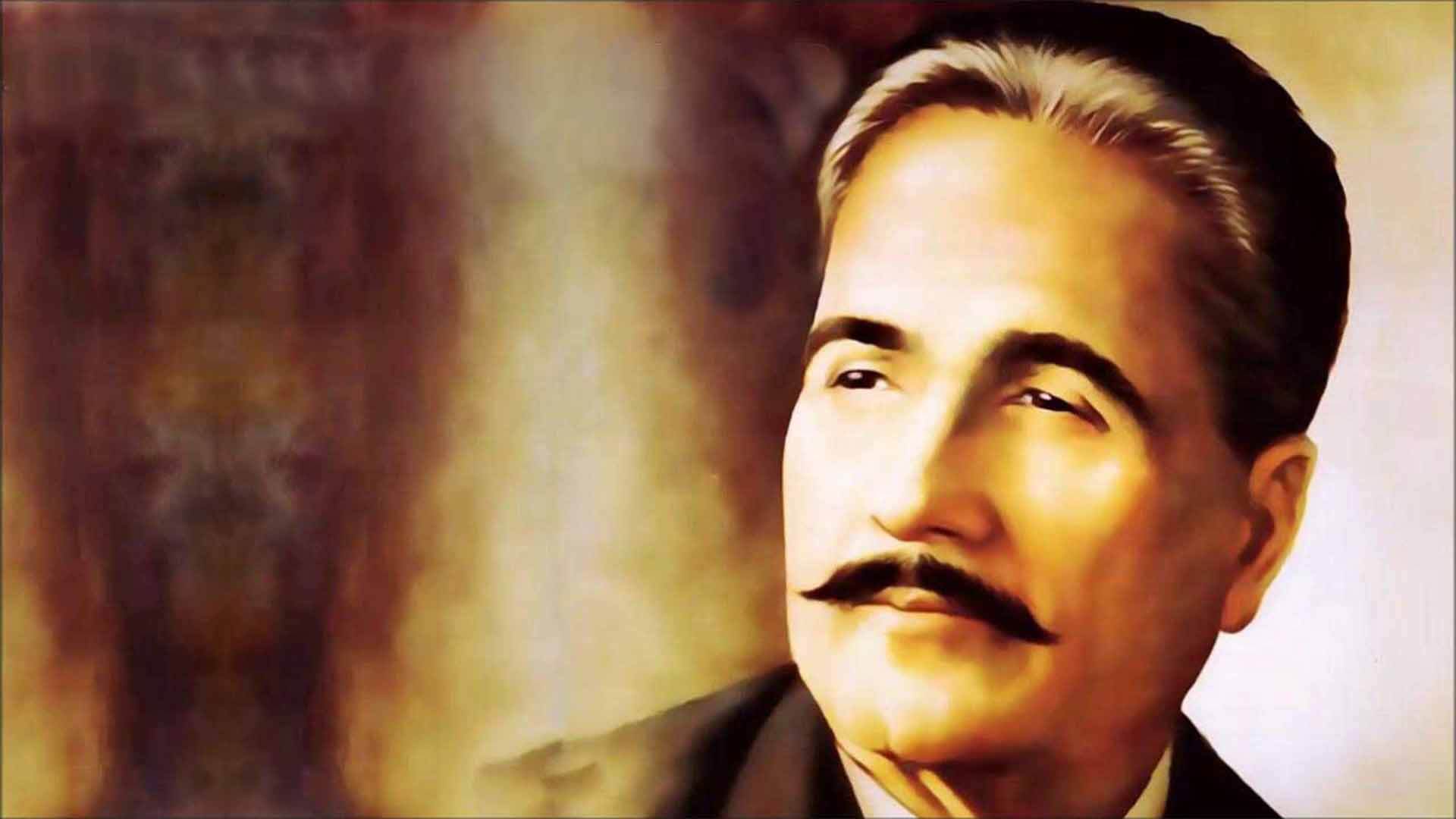
In India, he is remembered for the "Tarana-i-Hind," while in Pakistan, he is known for the other aspect of his life. He is regarded as the "Spiritual Father of the Nation" as well as the National Poet.
Background
Allama Mohammad Iqbal was born on 9th November 1877 in Sialkot, British India, now in Pakistan, in a family descended from the Kashmiri Brahmin Sapru clan, who converted to Islam around 200 years before Iqbal's birth. The first ancestor to convert to Islam has been identified as Haji Lal, a Sufi mystic. In the early 19th century, Iqbal's grandfather migrated to Punjab and settled in Sialkot, where Iqbal was born.
Philosophical Transformation
In 1904, Iqbal wrote "Saare Jahan Se Achcha" - Tarana-e-Hind, which was quickly embraced by the people of India as an anthem of opposition against British rule.
Soon after, he left for higher studies in England, and upon his return in 1908, he underwent a philosophical transformation from a secular, country-first mindset to a religion-first perspective. By 1910, he wrote the anthem of Muslims - "Tarana-e-Milli," using the same metre and rhyme scheme as "Saare Jahan Se Achcha." The song begins with the lines:
"Cheen-o-Arab humara, Hindostan humara
Muslim hain hum, watan hai saara jahaan humara"
Read the entire song here.
This philosophical transition is evident in his work before and after his time in Europe, where he increasingly focused on the past glory of Muslims and Islam.
By 1930, as the president of the All India Muslim League, he delivered the famous 1930 Allahabad Session address on 29th December, suggesting the concept of "Muslim India within India." He shared the fear, common among many Muslim leaders at the time, that Hindu dominance would isolate Muslims in terms of heritage, culture, and political influence.
Distinguished Philosopher, Failed Politician
No one can deny that he was a great thinker, philosopher, poet, writer, and academic scholar, earning titles such as Shair-e-Mashriq (Poet of the East) and Hakeem-ul-Ummat (The Sage of the Ummah). However, as a politician, he was not as successful. His vision of "Muslim India within India" eventually led to the foundation of Pakistan. Despite his political shortcomings, Pakistan honored him with titles like Mufakkir-e-Pakistan (The Thinker of Pakistan) and Musawwar-e-Pakistan (Artist of Pakistan). Sialkot is named "City of Iqbal" in his honor, and his birthday is celebrated as "Iqbal Day," a public holiday. However, Pakistan has failed to fully realize his vision.
The Allahabad address that formulated the two-nation theory eventually caused the tragedy during the partition of two nations. He also emphasized the fear of the aftermath, stating:
"Nor should the Hindus fear that the creation of autonomous Muslim states will mean the introduction of a kind of religious rule in such states. I have already indicated to you the meaning of the word religion, as applied to Islam."
However, if we look at the current situation in both countries, there is no denying the condition of minorities in Pakistan, which often contrasts with India's approach to celebrating diversity.
Conclusion
As a poet of the caliber of Ghalib, Iqbal initially envisioned a secular nation but later saw through the lens of religion. His own words reflect the situations on both sides of the border:
"Nations are born in the hearts of poets, they prosper and die in the hands of politicians."
While his vision might be debatable, there is no denying that it was marred by the greed of politicians. In closing, I leave you with one of his most iconic lines, which has helped me overcome disappointments and stay motivated:
"ख़ुदी को कर बुलंद इतना कि हर तकदीर से पहले,
ख़ुदा बन्दे से ख़ुद पूछे बता तेरी रज़ा क्या है"
Elevate thyself to such an extent that before every decree,
The God himself asks the man, "What is your desire?"
Read the entire ghazal here.